What lowers LDL, ranked by size
On this page
- Why most lists of cholesterol foods don’t help
- Every change, sized
- The fat swap, in food you’d eat
- Fiber, oats and beans
- The portfolio diet, and what happens in real life
- What about plant sterols and the supplement aisle?
- Coffee, eggs and the smaller things
- The fight: do food changes prevent heart attacks?
The two biggest food changes trials have measured are moving saturated fat to vegetable oils (about 2 mg/dL of LDL for each 1% of your calories) and soluble fiber (about 13 mg/dL from 10 g of psyllium a day). Weight loss and oats add a little more. Pills sold as natural statins did nothing measurable.
What we’d do
Start with the two biggest. Cook with olive or canola oil instead of butter, swap fatty meat and cheese for fish, beans and nuts, and build up to about 10 g of psyllium husk a day. Then add oats, beans and soy where they fit. Skip the supplement aisle. Retest in 6 to 12 weeks and see what your own body did, because people respond differently.
If you remember three things
- Replace saturated fat, rather than only cutting it. LDL falls most when vegetable oils take its place.
- Each change is about 5 to 15 points. A few together got close to a starter statin in a month-long trial.
- Don’t add the numbers up. Trials tested them one at a time, and together they usually add to less than the sum.
Why most lists of cholesterol foods don’t help
Search for foods that lower cholesterol and you get lists of 15 or 20: oats, beans, nuts, avocado, garlic, green tea, dark chocolate. They’re like a shopping list with no prices on it. You can’t tell whether oatmeal takes off 2 points or 20, so you can’t tell what to do first.
Next to the lists sit the bottles. Red yeast rice, garlic, plant sterol capsules and fish oil are sold as natural ways to do what a statin does. In 2023 they got a fair test, and none of them beat a sugar pill.
Every change, sized
Each row comes from its own trials, at the size those trials measured. LDL in mg/dL, with mmol/L in brackets where it helps.
| Change | LDL change | From |
|---|---|---|
| The portfolio diet: soy protein, nuts, viscous fiber and plant sterols, together | −28.6% in one month (about 46 off an LDL of 160) | One trial of 46 adults, 2003 |
| Moving 5% of your calories from saturated fat to vegetable oils and nuts | About −10.6 (9.7 to 11.8) | 69 feeding trials. To olive oil, about −8.1. To carbs, about −6.4 |
| 10 g of psyllium husk a day | About −13 (10 to 15), or −0.33 mmol/L | 28 trials, 1,924 people |
| Losing weight, any amount, over 6 to 12 months | About −8 | 83 trials pooled |
| About 3.5 g of oat beta-glucan a day | About −7 (5 to 9) | 58 trials, 3,974 people |
| Less sugar | About −5 (2 to 7) | 37 trials |
| Six popular supplements, 28 days | No better than a sugar pill | One trial of 190 adults, 2023 |
| For scale: a moderate statin | −30 to −49% | The 2026 guideline. High intensity takes off 50% or more |
These are averages. Some people drop twice as much and some barely move, which is why your own retest tells you more than any table. What would lower yours? lays these out against your own number and your goal.
The fat swap, in food you’d eat
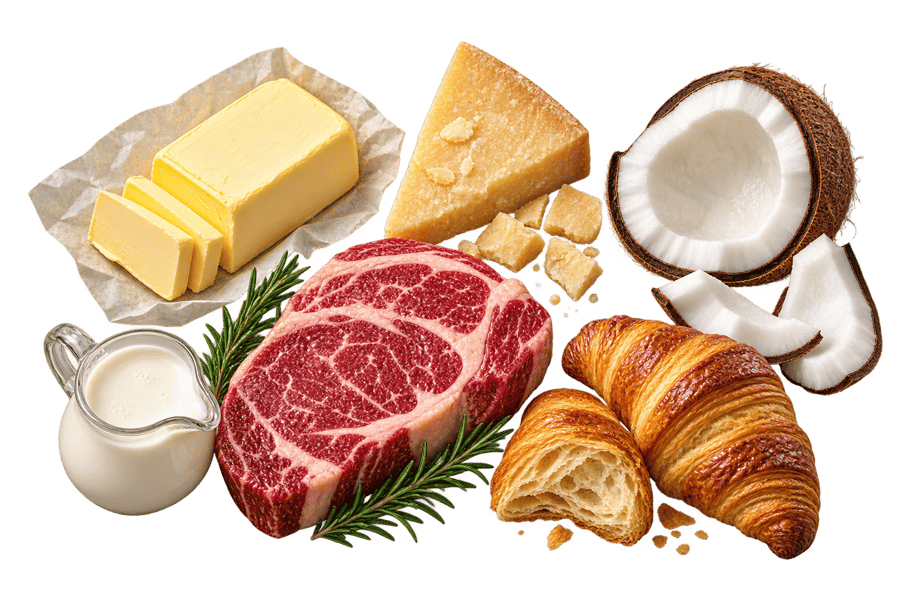
At 2,000 calories a day, 1% of your calories is about 2.2 g of fat, and each 2.2 g of saturated fat a day you replace with vegetable oils takes about 2.1 mg/dL off your LDL, by Mensink’s pooled analysis for the World Health Organization. With olive oil it’s about 1.6, and with carbohydrate about 1.3.
| Food | Saturated fat (USDA) |
|---|---|
| 1 tbsp coconut oil | 11.2 g, about 5% of a 2,000 calorie day on its own |
| 1 tbsp butter | 7.3 g |
| A butter croissant | 6.7 g |
| 1 oz of cheddar | 5.4 g |
| 1 tbsp olive oil | 1.9 g |
| 1 tbsp canola oil | 1.0 g |
Swap 2 tablespoons of butter a day for olive oil and that’s about 8 mg/dL off, in Mensink’s numbers. Swap 1 tablespoon of coconut oil for olive oil and it’s about 7. The swap only works if the saturated fat is replaced. Cutting butter and eating more white bread moves LDL less than cutting butter and cooking in oil. Higher or lower is a game of ten food pairs that shows how surprising the grams can be.
Fiber, oats and beans
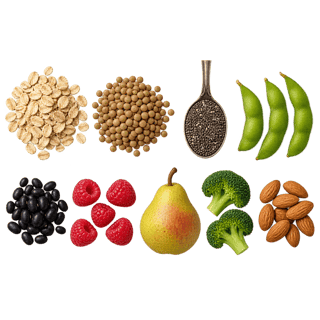
Soluble fiber turns into a gel in your gut that carries bile out with it, and your liver pulls LDL from your blood to make more bile (how it works). Psyllium husk is the most tested, at about 13 mg/dL from 10 g a day. Oats work the same way more gently, about 7 mg/dL from about 3.5 g of oat beta-glucan a day. The FDA lets foods made with whole oats or barley make a heart claim at 3 g of beta-glucan a day. Check the label for grams of soluble fiber rather than counting bowls.
Build psyllium up over a week, split it over meals with a full glass of water each time, and ask your pharmacist about spacing it from your medicines. How much psyllium should I take? has the details.
The portfolio diet, and what happens in real life
In 2003 David Jenkins and his team in Canada put 46 adults with high cholesterol on one of three diets for a month. A very low saturated fat diet lowered LDL 8.0%. The same diet with a starter statin (20 mg of lovastatin) lowered it 30.9%. The “portfolio” diet, built around soy protein, almonds, viscous fiber and plant sterols, lowered it 28.6%. In the portfolio, the guideline notes, the sterols come in an enriched margarine. The statin and the diet were too close to call apart.
Then they tried it in real life. In a 2011 trial, 351 adults at four Canadian centers got 6 months of advice on the portfolio diet or a standard low saturated fat diet, and cooked for themselves. The portfolio groups lowered LDL about 13 to 14%, roughly 24 to 26 mg/dL, against 3% on the standard advice. The people who stuck to it most lowered it most. That’s half the effect of the month when the food was planned for them, and it’s still the biggest food result we know of.
What about plant sterols and the supplement aisle?
Plant sterols can lower LDL. In 124 studies, 0.6 to 3.3 g a day of plant sterols or stanols lowered it 6 to 12% on average, which is why a sterol margarine is part of the portfolio diet.
Pills are a different story. In the SPORT trial in 2023, 190 adults at higher heart risk took a 5 mg statin, a placebo, or one of six supplements for 28 days: fish oil, cinnamon, garlic, turmeric, plant sterols or red yeast rice. The statin lowered LDL 35% more than placebo. None of the six lowered it more than placebo. The 2026 guideline now recommends against supplements for lowering LDL or triglycerides. There’s more in the supplements myth.
Coffee, eggs and the smaller things
- Coffee. Unfiltered coffee, like French press or boiled coffee, raised LDL in a pooled analysis of 14 trials. Paper-filtered coffee did very little (does coffee raise cholesterol?).
- Eggs. The cholesterol in food moves LDL less than saturated fat, says the 2026 guideline. Watch the butter and bacon beside them (do eggs raise cholesterol?).
- Sugar. Higher-sugar diets raised LDL about 5 points in 37 trials, and triglycerides about 10 (triglycerides and HDL).
The fight: do food changes prevent heart attacks?
“These trials ran for weeks and measured a blood number. Nobody showed that psyllium prevents a single heart attack.” That’s a fair point. The food trials were short, and they measured LDL without counting heart attacks.
What connects them is the evidence that LDL itself causes heart disease. Statin trials in about 170,000 people found each 39 mg/dL a statin took off cut heart attacks and strokes by about a fifth. People born with genes that lower LDL had far less heart disease. We expect LDL lowered by food to help in the same way, and we’d still check with a retest that your LDL really fell. What nobody knows is exactly how much the changes overlap when you do several at once.
14 sources
- Mensink RP, Effects of saturated fatty acids on serum lipids and lipoproteins, World Health Organization, 2016, as tabulated by Food Standards Australia New Zealandfoodstandards.gov.au
- Jovanovski E and others, Effect of psyllium fiber on LDL cholesterol and alternative lipid targets, American Journal of Clinical Nutrition, 2018pubmed.ncbi.nlm.nih.gov
- Ho HV and others, The effect of oat beta-glucan on LDL-cholesterol, non-HDL-cholesterol and apoB, British Journal of Nutrition, 2016pubmed.ncbi.nlm.nih.gov
- Jenkins DJ and others, Effects of a dietary portfolio of cholesterol-lowering foods vs lovastatin on serum lipids and C-reactive protein, JAMA, 2003pubmed.ncbi.nlm.nih.gov
- Jenkins DJ and others, Effect of a dietary portfolio of cholesterol-lowering foods given at 2 levels of intensity of dietary advice on serum lipids in hyperlipidemia, JAMA, 2011pubmed.ncbi.nlm.nih.gov
- Zomer E and others, Interventions that cause weight loss and the impact on cardiovascular risk factors, Obesity Reviews, 2016pubmed.ncbi.nlm.nih.gov
- Te Morenga LA and others, Dietary sugars and cardiometabolic risk: systematic review and meta-analyses of randomized controlled trials, American Journal of Clinical Nutrition, 2014pubmed.ncbi.nlm.nih.gov
- Ras RT, Geleijnse JM, Trautwein EA, LDL-cholesterol-lowering effect of plant sterols and stanols across different dose ranges, British Journal of Nutrition, 2014pubmed.ncbi.nlm.nih.gov
- Laffin LJ and others, Comparative effects of low-dose rosuvastatin, placebo, and dietary supplements on lipids and inflammatory biomarkers (SPORT), JACC, 2023pubmed.ncbi.nlm.nih.gov
- Jee SH and others, Coffee consumption and serum lipids: a meta-analysis of randomized controlled clinical trials, American Journal of Epidemiology, 2001pubmed.ncbi.nlm.nih.gov
- Blumenthal RS, Morris PB, Gaudino M and others, 2026 ACC/AHA guideline on the management of dyslipidemia, JACC and Circulation, 2026doi.org
- US Department of Agriculture, FoodData Central, SR Legacy 173410 (butter), 171412 (coconut oil), 171413 (olive oil), 173414 (cheddar) and 174987 (croissant)fdc.nal.usda.gov
- Cholesterol Treatment Trialists' Collaboration, Efficacy and safety of more intensive lowering of LDL cholesterol, Lancet, 2010pubmed.ncbi.nlm.nih.gov
- US Code of Federal Regulations, 21 CFR 101.81, Health claims: soluble fiber from certain foods and risk of coronary heart diseaselaw.cornell.edu