Why LDL is a lifetime number
On this page
Plaque builds with how high your LDL is and how many years it stays there. People born with a gene that kept their LDL 28% lower had 88% less heart disease over 15 years, far more than the same drop buys when it starts in middle age. Lower it early and keep it down.
What we’d do
Treat a high LDL at 30 as seriously as a high LDL at 60, because the 30 year old has more years ahead for it to work on. Start the food changes as soon as you see the number, and test at least every 5 years from 19 so you see it early. If your LDL stays at 160 or more, bring up medicine with your doctor even if your 10-year risk looks low, since the guideline now counts the years too.
If you remember three things
- Years count as much as the level. A modest drop held for decades beat a bigger drop held for five years.
- LDL creeps up through your 20s and 30s. About 1 to 2 points a year on average, and the guideline says that rise isn’t the healthy normal.
- Plaque starts young. Autopsies of young people who died in accidents found it in the heart arteries, more of it with higher cholesterol.
Isn’t cholesterol something to worry about later?
Most people hear about cholesterol around 50, often after a friend’s heart attack. A 10-year risk score for a healthy 30 year old comes out tiny, so the number feels safe to ignore. And it’s true that the chance of a heart attack in the next 10 years is small at 30.
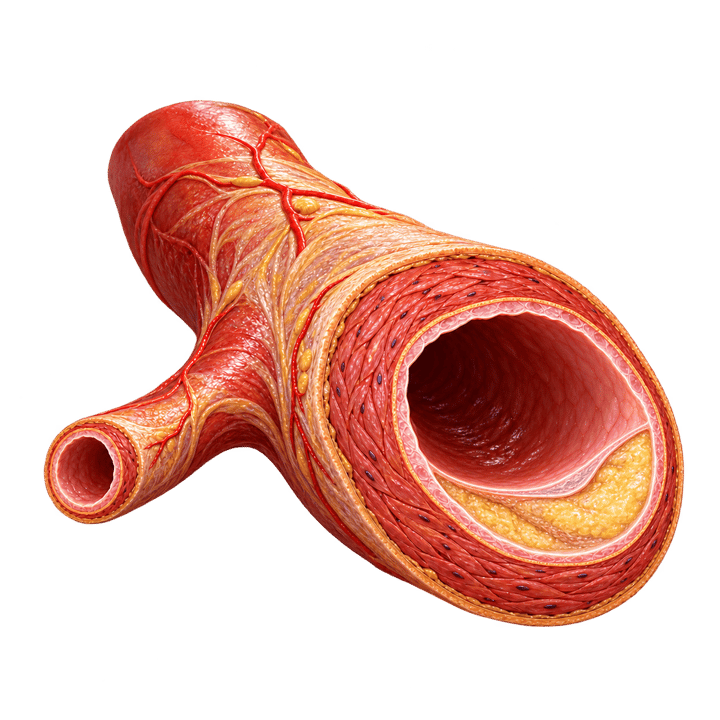
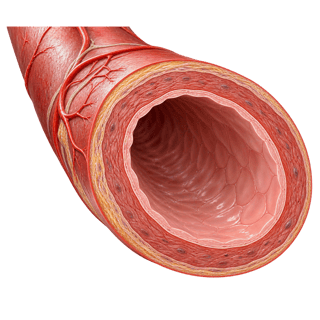
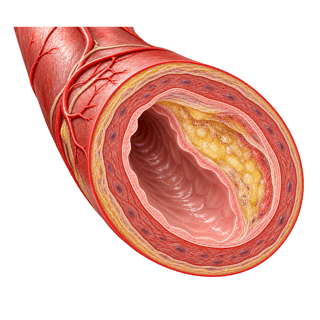
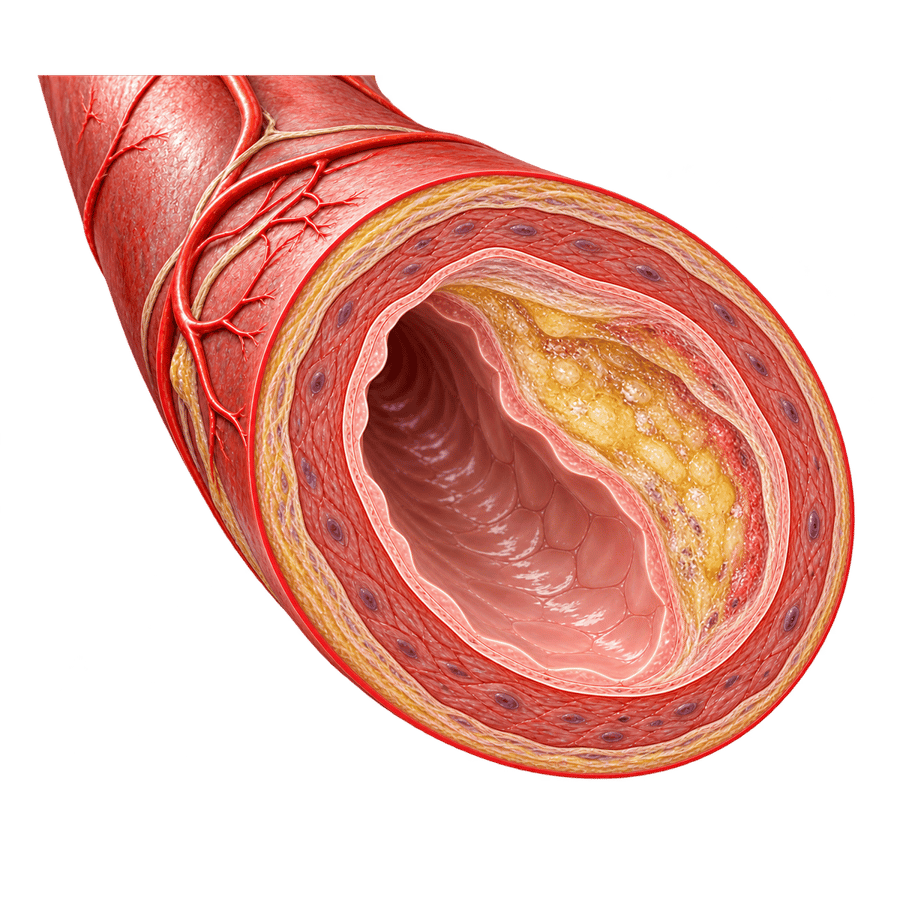
The catch is in the word “next”. A 10-year score can’t see what 30 years of high LDL will do. Plaque doesn’t appear at 55. It builds from particles getting stuck in your artery walls, one at a time, from your teens on, and the total depends on how many particles were there and for how long.
Like pack-years for smoking
Doctors count smoking in pack-years: packs a day times the number of years. Twenty years at a pack a day counts the same as ten years at two packs. LDL works much the same way. What builds plaque is roughly your LDL level multiplied by the years you’ve had it, so a modest number held for a long time can do as much as a high number held for a short one.
The comparison runs out at the start. You chose to light the first cigarette, but you had LDL from the day you were born, and some people are born with a lot more of it.
The people born with lower LDL
The clearest evidence comes from people whose genes did the experiment for them. In 2006 the geneticists Jonathan Cohen and Helen Hobbs and their colleagues looked at 15 years of records from ARIC, a large US heart study. They checked everyone for changes in PCSK9, a gene for a protein that destroys the liver’s LDL receptors.
- Among 3,363 Black participants, 2.6% carried a broken copy. Their LDL was 28% lower, and they had 88% less coronary heart disease over the 15 years.
- Among 9,524 white participants, 3.2% carried a milder change. Their LDL was 15% lower, and they had 47% less heart disease.
These people didn’t diet or take pills. They just had a little less LDL every day of their lives. The researchers pointed out that the group had high rates of other heart risk factors, and the carriers were still protected.
In 2012 Brian Ference and his colleagues pooled nine gene variants of this kind from 312,321 people. For each 39 mg/dL (1 mmol/L) of LDL that someone’s genes kept lower from early life, their risk of coronary heart disease was 54.5% lower. That’s three times the benefit per point that statins give when people start them later in life.
What the drug trials show
The genes tell you about a lifetime. The trials tell you what happens when you lower LDL on purpose. The Cholesterol Treatment Trialists pooled 26 statin trials with about 170,000 people. Each 39 mg/dL taken off cut heart attacks, strokes and artery procedures by about a fifth (a rate ratio of 0.78), over about five years, and deaths from any cause by 10%. The researchers found no level below which the benefit stopped.
Put the two side by side and you get the guideline’s message. A drug started at 60 helps a lot. The same drop held from 20 helps far more, because the plaque never got the chance to build. Roger Blumenthal, who chaired the 2026 guideline, compared it to blood pressure, where lower for longer also gives much greater protection.
When does it start?
In childhood. The Bogalusa Heart Study in Louisiana did autopsies on 204 young people aged 2 to 39 who had died, mostly from accidents. Fatty streaks and early plaques in the heart arteries grew with age. And the young people with higher LDL, blood pressure and weight before they died had more of them.
It climbs through your 20s and 30s. The 2026 guideline says LDL and non-HDL rise an average of 1 to 2 mg/dL a year in young adulthood, and calls that rise normal but not optimal. It also notes that in the CARDIA study of young adults, LDL levels about 20 points lower than those seen in middle age were already linked to heart risk, so the guideline asks for counseling on habits to start at levels that would look normal for a 50 year old.
It peaks in middle age, then splits by sex. In US adults tested from 2021 to 2023, 6.0% of those 20 to 39 had a total cholesterol of 240 or more, 16.7% of those 40 to 59, and 11.3% of those 60 and older. Over 60 the split is wide: 16.4% of women against 5.6% of men, partly because LDL jumps around menopause (why cholesterol goes up after menopause).
What it means for you
- Test from 19. The guideline asks every adult for a panel at least every 5 years from age 19, and children once at 9 to 11.
- Don’t wait for a bad 10-year score. Food changes cost little and start working within weeks (how to lower your cholesterol naturally).
- At 160 or more, talk about the years. For adults 30 to 59 at low 10-year risk with an LDL of 160 to 189, the guideline calls a moderate statin reasonable “to reduce cumulative exposure”.
- At 190 or more, see a doctor now. That’s where the guideline looks for an inherited cause (when it’s your genes).
The best case against
“No trial has given statins to 25 year olds and waited 40 years for heart attacks.” That’s true, and the guideline says no clinical trial has shown benefits or harms of cholesterol screening in younger adults. The case for starting early rests on three other kinds of evidence put together. The gene studies show a lifetime of lower LDL protects. The drug trials show lowering LDL on purpose protects, with no floor found yet. And studies of the artery wall show how particles get trapped there, which explains why time adds up. Each one alone has gaps. Together they point the same way, which is why the guideline now counts years as well as risk.
9 sources
- Cohen JC, Boerwinkle E, Mosley TH, Hobbs HH, Sequence variations in PCSK9, low LDL, and protection against coronary heart disease, NEJM, 2006pubmed.ncbi.nlm.nih.gov
- Ference BA and others, Effect of long-term exposure to lower low-density lipoprotein cholesterol beginning early in life on the risk of coronary heart disease: a Mendelian randomization analysis, JACC, 2012pubmed.ncbi.nlm.nih.gov
- Cholesterol Treatment Trialists' Collaboration, Efficacy and safety of more intensive lowering of LDL cholesterol: a meta-analysis of data from 170,000 participants in 26 randomised trials, Lancet, 2010pubmed.ncbi.nlm.nih.gov
- Berenson GS and others, Association between multiple cardiovascular risk factors and atherosclerosis in children and young adults (the Bogalusa Heart Study), NEJM, 1998pubmed.ncbi.nlm.nih.gov
- Blumenthal RS, Morris PB, Gaudino M and others, 2026 ACC/AHA guideline on the management of dyslipidemia, JACC and Circulation, 2026doi.org
- American College of Cardiology, ACC/AHA issue updated guideline for managing lipids, cholesterol, press release, 13 March 2026acc.org
- Borén J and others, Low-density lipoproteins cause atherosclerotic cardiovascular disease, European Heart Journal, 2020academic.oup.com
- CDC NCHS Data Brief 515, Total and high-density lipoprotein cholesterol in adults: United States, August 2021 to August 2023cdc.gov
- Matthews KA and others, Are changes in cardiovascular disease risk factors in midlife women due to chronological aging or to the menopausal transition? (SWAN), JACC, 2009pubmed.ncbi.nlm.nih.gov