Where cholesterol comes from and where it goes
On this page
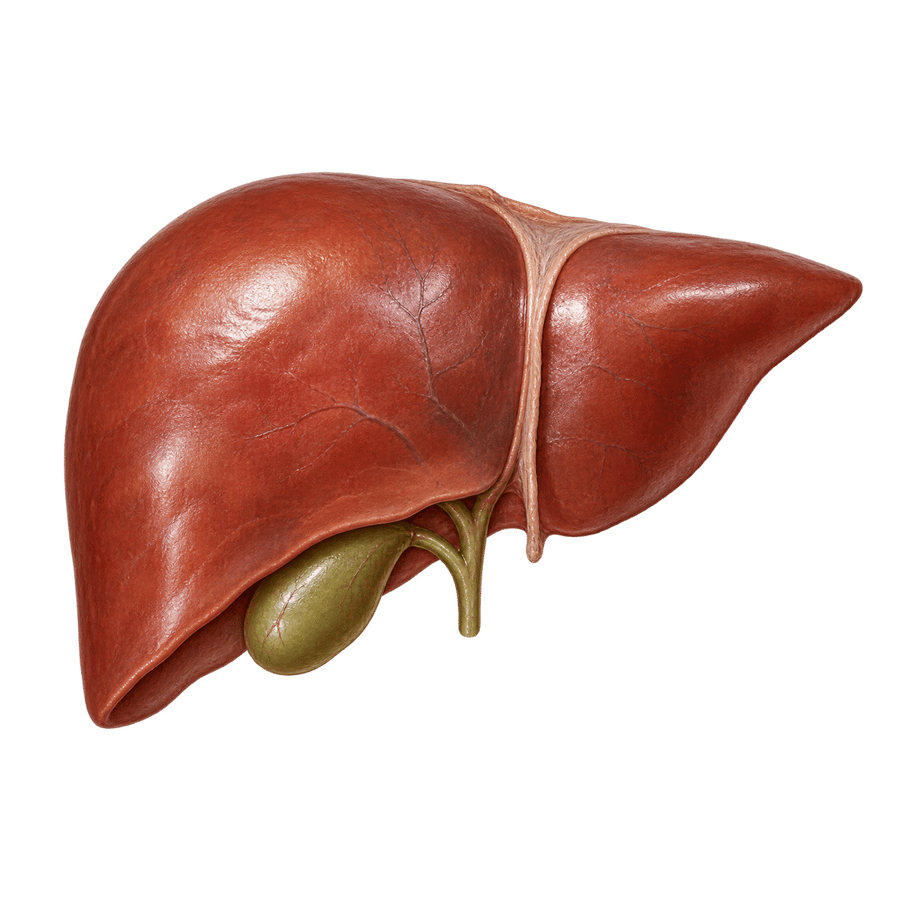
Your body makes all the cholesterol it needs, mostly in your liver, and ships it around in particles. The liver also pulls LDL particles back out of your blood through receptors on its cells. How many receptors you have, and how busy they are, sets your LDL more than the cholesterol on your plate.
What we’d do
Stop counting the cholesterol in eggs and shrimp and look at the saturated fat around them, since that’s what slows your liver’s clearing. Add soluble fiber, which makes the liver pull in more LDL. And if your LDL is high even though you eat well, take that as a hint about your genes and show it to a doctor.
If you remember three things
- Your liver is the main control. It makes cholesterol and it clears LDL, through receptors that work like a drain.
- Food works on the drain. Saturated fat slows it. Soluble fiber and unsaturated fats speed it up.
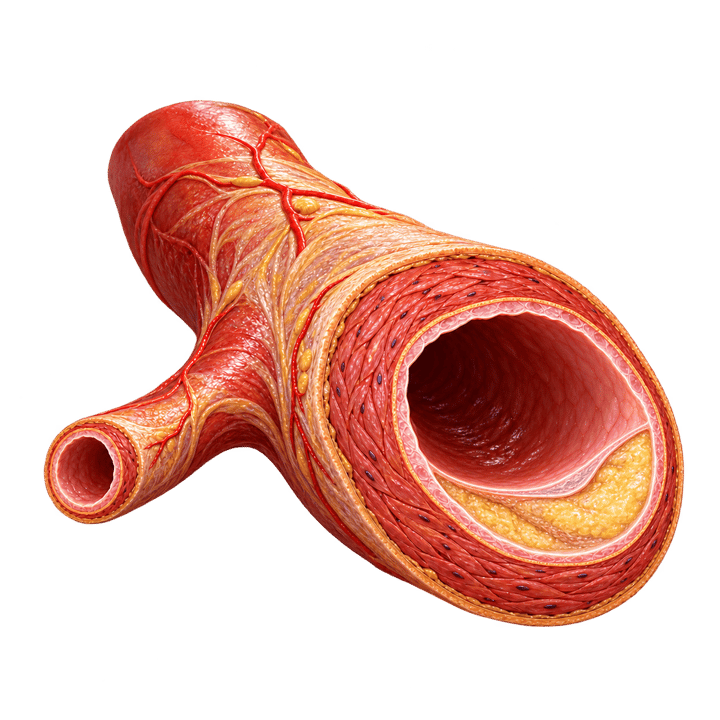
- Plaque is particles that get stuck. LDL that slips into an artery wall and stays is what builds it, slowly, over decades.
Isn’t cholesterol something to avoid?
For decades the advice was to cut cholesterol from food, so eggs and shrimp got the blame. It made sense at the time, since cholesterol builds up in arteries and less of it going in should mean less of it there.
But your body needs cholesterol and makes plenty of its own. More than 90% of the cholesterol in your body sits in the walls of your cells. Your body turns some of it into hormones like estrogen and testosterone, some into vitamin D, and a lot into bile, which your gut needs to absorb fat. The problem is cholesterol in the wrong place, in your artery walls, carried there by particles that stay too long in your blood.
The 2026 US guideline puts the food question plainly. Eating patterns that limit saturated fat and add unsaturated fat lower LDL more reliably than cutting the cholesterol in food.
The sink and the drain
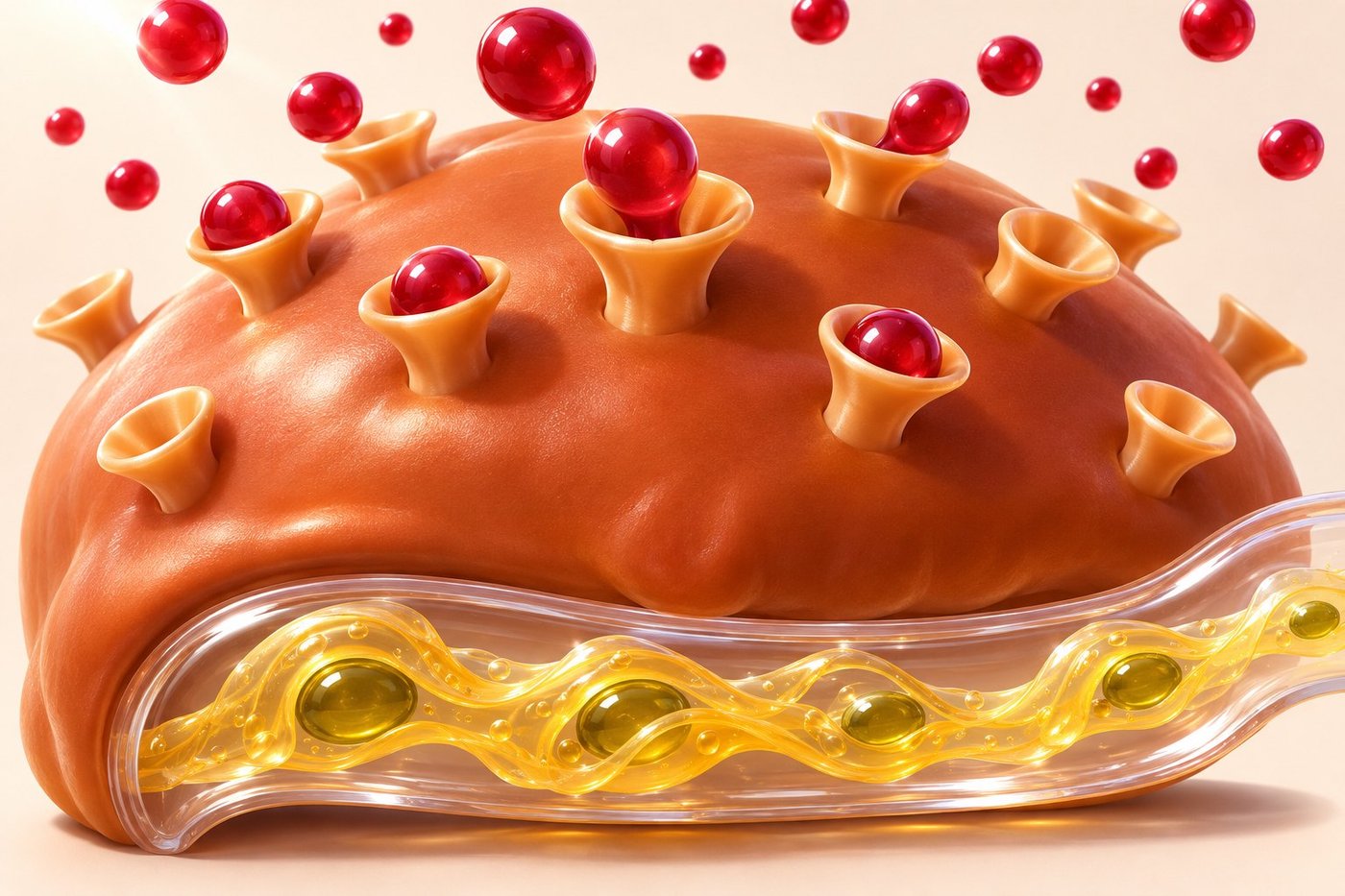
Think of your blood as a sink with the tap running. Your liver keeps the tap on, sending cholesterol out in particles. Your liver also pulls LDL back in through receptors on its cells, which work like the drain. Your LDL number is how full the sink is.
Two people can eat the same food and have very different LDL, because their drains are different sizes. Nearly everything that lowers LDL, from psyllium to statins, works by opening the drain wider. The picture leaves one thing out. A sink only holds water, but your blood runs past the walls of your arteries, and the longer LDL stays in it, the more chances it has to slip into a wall.
How it works, step by step
- Your liver makes cholesterol and packs it into particles. Cholesterol doesn’t mix with blood, so it travels inside particles called lipoproteins, wrapped in a coat of protein and fat. Food adds some too, from your gut.
- LDL is the main carrier. Each LDL particle holds about 1,500 cholesterol molecules in its core and one large protein, ApoB, on its surface. That one protein per particle is why an ApoB test counts particles.
- Receptors pull LDL back out. The ApoB protein locks onto LDL receptors on your cells, most of them in the liver, and the whole particle gets pulled inside.
- A full cell makes fewer receptors. When a liver cell has enough cholesterol, it builds fewer receptors, so more LDL stays in your blood. When it runs short, it builds more, and your LDL falls.
- Particles that stay in the blood can get stuck in the artery wall. Researchers found that LDL builds up in the wall mainly because its ApoB sticks to the wall’s tissue and gets held there. Over years that stuck cholesterol becomes plaque.
How food changes the drain
Saturated fat slows it down. Studies in animals and people show saturated fats raise LDL both by making more of it and by slowing how fast it’s cleared, while the fats in vegetable oils raise the number of liver receptors. Each 1% of your calories moved from saturated fat to vegetable oils lowers LDL about 2.1 mg/dL, in 69 controlled feeding trials pooled for the World Health Organization. At 2,000 calories a day, 1% is about 2.2 g of fat.
Soluble fiber makes the liver hungry. Psyllium forms a gel in your gut that carries bile out with it. Your liver has to make new bile, and it uses cholesterol to do it. In a 1992 trial of 20 men, 15 g of psyllium a day for 40 days lowered LDL from 184 to 169 mg/dL, and the men whose LDL fell most were the ones whose bodies made more bile. Across 28 trials, about 10 g a day lowered LDL about 13 mg/dL.
The cholesterol in food counts for less. When you eat more cholesterol, your cells make less of their own, which is part of why eggs move LDL less than people expect. There’s more on the eggs question.
The doctors who found the drain
In the early 1970s two American doctors, Michael Brown and Joseph Goldstein, were studying a family disease called familial hypercholesterolemia (FH). People who inherit one faulty copy have cholesterol two to three times normal and tend to get heart disease between 35 and 55. People who inherit two faulty copies can have heart attacks as teenagers or younger.
Brown and Goldstein grew cells from patients in the lab and found the reason in 1973. Healthy cells had receptors that grabbed LDL from the fluid around them. Cells from people with the severe form had no working receptors at all, and cells from people with the milder form had about half. The drain was broken.
The proof came from a 6 year old girl with the severe form who had already had several heart attacks. Doctors gave her a new heart and a new liver in one operation. Her new liver came with working receptors, and her cholesterol fell from about 1,200 mg/dL to about 300, a quarter of what it had been. Brown and Goldstein won the Nobel Prize in 1985.
Why the PCSK9 gene changed medicine
A protein called PCSK9 destroys LDL receptors. It latches onto a receptor and marks it for breakdown, so the drain gets narrower. People born with a broken PCSK9 gene keep more receptors, have lower LDL and get less heart disease. In one 15 year US study, Black participants with a broken copy had 28% lower LDL and 88% less coronary heart disease. Drugs that block PCSK9 now do the same thing on purpose.
What this explains about your own panel
- Why genes can beat a good diet. Your drain size is mostly inherited. A slim person who eats well can still have an LDL over 190, and that’s where the guideline looks for FH (when it’s your genes).
- Why the swap beats the cut. Taking saturated fat out only helps the drain if something better goes in its place, and vegetable oils help most (what lowers LDL).
- Why LDL is slow and triglycerides are fast. LDL reflects how your drain is set, which changes over weeks. Triglycerides ride in bigger particles that carry fat from your last meals, so a meal raises them for up to six hours (triglycerides and HDL).
- Why the years count. Plaque builds from particles getting stuck, one at a time, for as long as there are too many of them (why LDL is a lifetime number).
More detail: the other particles on your panel
Your liver first sends cholesterol out in larger particles called VLDL, which also carry triglycerides. As they drop off triglycerides around the body, they shrink into LDL. After a meal, your gut sends out its own large particles, chylomicrons, loaded with the fat you just ate. HDL particles are small and dense, and they pick up cholesterol from tissues. Every particle except HDL carries one ApoB protein, which is why non-HDL cholesterol (your total minus HDL) and ApoB both count the particles that can get stuck in an artery wall.
11 sources
- The Nobel Assembly at the Karolinska Institute, The Nobel Prize in Physiology or Medicine 1985 (Brown and Goldstein), press releasenobelprize.org
- MedlinePlus, Cholesterol, US National Library of Medicinemedlineplus.gov
- Borén J and others, Low-density lipoproteins cause atherosclerotic cardiovascular disease: pathophysiological, genetic, and therapeutic insights. A consensus statement from the European Atherosclerosis Society, European Heart Journal, 2020academic.oup.com
- Fernandez ML, West KL, Mechanisms by which dietary fatty acids modulate plasma lipids, Journal of Nutrition, 2005pubmed.ncbi.nlm.nih.gov
- Everson GT, Daggy BP, McKinley C, Story JA, Effects of psyllium hydrophilic mucilloid on LDL-cholesterol and bile acid synthesis in hypercholesterolemic men, Journal of Lipid Research, 1992pubmed.ncbi.nlm.nih.gov
- Horton JD, Cohen JC, Hobbs HH, PCSK9: a convertase that coordinates LDL catabolism, Journal of Lipid Research, 2009pubmed.ncbi.nlm.nih.gov
- Cohen JC, Boerwinkle E, Mosley TH, Hobbs HH, Sequence variations in PCSK9, low LDL, and protection against coronary heart disease, NEJM, 2006pubmed.ncbi.nlm.nih.gov
- Blumenthal RS, Morris PB, Gaudino M and others, 2026 ACC/AHA guideline on the management of dyslipidemia, JACC and Circulation, 2026doi.org
- Jovanovski E and others, Effect of psyllium fiber on LDL cholesterol and alternative lipid targets, American Journal of Clinical Nutrition, 2018pubmed.ncbi.nlm.nih.gov
- Mensink RP, Effects of saturated fatty acids on serum lipids and lipoproteins, World Health Organization, 2016, as tabulated by Food Standards Australia New Zealandfoodstandards.gov.au
- Langsted A, Freiberg JJ, Nordestgaard BG, Fasting and nonfasting lipid levels, Circulation, 2008pubmed.ncbi.nlm.nih.gov