Coconut oil is good for your cholesterol
Short answerNo
On this page
No. Coconut oil is mostly saturated fat, and the 2026 US guideline lists it with butter, red meat and palm oil as a source. Across 16 trials it raised LDL about 10 mg/dL compared with vegetable oils. It raises HDL too, but that doesn’t make up for it.
What we’d do
Use coconut oil the way you’d use butter, now and then for flavor, and not as your everyday cooking fat. For daily cooking, use olive oil or canola oil. If you switched to coconut oil because it sounded healthy and your LDL went up afterward, switching back is one of the easiest changes you can make.
If you remember three things
- A tablespoon holds about 11 g of saturated fat. More than a tablespoon of butter, and about 5% of a 2,000 calorie day on its own.
- It raised LDL against vegetable oils. About 10 mg/dL across 16 trials.
- The HDL rise doesn’t help. Raising HDL hasn’t lowered heart risk in trials, and the guideline gives HDL no goal.
Why people believe it
Coconut oil had a big run as a health food. It’s from a plant, it’s sold as “virgin” and “cold-pressed”, and it’s rich in medium-chain fats that get talked up for energy and weight. Some people noticed their HDL went up when they used it, and HDL is the “good” one, so it sounded like a win.
One trial gave the idea real support. In 2018, Kay-Tee Khaw and her colleagues in Cambridge, England, with volunteers recruited by the BBC, had 94 adults aged 50 to 75 eat 50 g a day of coconut oil, butter or olive oil for four weeks. Butter raised LDL much more than coconut oil, about 16 mg/dL (0.42 mmol/L) more, and coconut oil came out close to olive oil for LDL.
Like a raise that comes with a bigger rent increase
Picture a raise of $4 a month that comes with a rent increase of $10. You’d notice the raise, and you’d still be worse off. Coconut oil does something like that to your cholesterol. Across 16 trials it raised HDL about 4 mg/dL and LDL about 10, and of the two, only LDL is a number whose lowering has prevented heart attacks.
What the studies found
All the trials together
16 trials, Neelakantan, Seah and van Dam, Circulation 2020
Against other vegetable oils (not palm), coconut oil raised LDL by 10.47 mg/dL and HDL by 4.00. The result held when they left out the weaker trials.
The results varied a lot from trial to trial.
Coconut against butter and olive oil
94 adults aged 50 to 75, Khaw and colleagues, BMJ Open 2018
50 g a day for four weeks. Butter raised LDL about 16 mg/dL more than coconut oil, and coconut oil was close to olive oil for LDL.
One short trial. The researchers wrote that it didn’t change the advice to cut saturated fat.
The 2026 US guideline
Its section on food and LDL
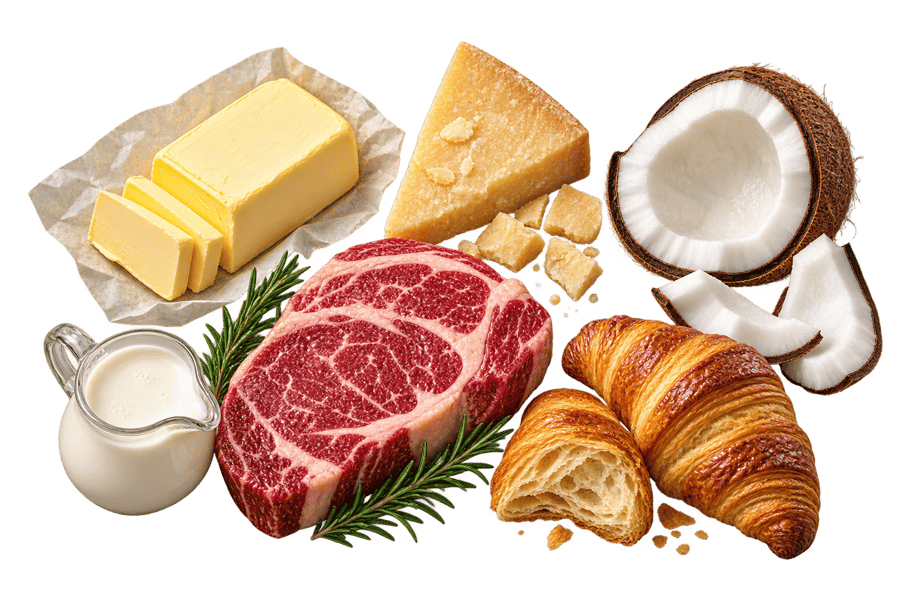
Saturated fat “is typically found in red meat, butter, high-fat milk, coconut oil, and palm and palm kernel oil”, and replacing it with unsaturated fats lowers LDL.
The guideline sets no separate rule for coconut oil. It counts it with the other saturated fats.
The numbers, per tablespoon
| Fat, 1 tbsp | Saturated fat (USDA) |
|---|---|
| Coconut oil | 11.2 g |
| Butter | 7.3 g |
| Olive oil | 1.9 g |
| Canola oil | 1.0 g |
Each 1% of your calories moved from saturated fat to vegetable oils lowers LDL about 2.1 mg/dL, and to olive oil about 1.6, in Mensink’s pooled analysis of 69 feeding trials for the World Health Organization. At 2,000 calories a day, 1% is about 2.2 g, so swapping one tablespoon of coconut oil a day for olive oil works out to about 7 mg/dL off your LDL, about the same as 3.5 g of oat beta-glucan a day did in trials.
So was the Cambridge trial wrong?
It’s one piece of the picture. It was a single four week trial of 94 people, and it compared coconut oil mostly with butter, which is even worse for LDL. When researchers pooled 16 trials against vegetable oils, coconut oil raised LDL. Both results fit together, since coconut oil may be a little better than butter for LDL and is worse than the oils you could use instead.
The HDL rise is real, and it’s not a reason to choose it. When scientists raised HDL with drugs or found people born with genes that raise it, heart attacks didn’t fall (the HDL myth).
6 sources
- Blumenthal RS, Morris PB, Gaudino M and others, 2026 ACC/AHA guideline on the management of dyslipidemia, JACC and Circulation, 2026doi.org
- Neelakantan N, Seah JYH, van Dam RM, The effect of coconut oil consumption on cardiovascular risk factors: a systematic review and meta-analysis of clinical trials, Circulation, 2020pubmed.ncbi.nlm.nih.gov
- Khaw KT and others, Randomised trial of coconut oil, olive oil or butter on blood lipids and other cardiovascular risk factors in healthy men and women, BMJ Open, 2018pubmed.ncbi.nlm.nih.gov
- Mensink RP, Effects of saturated fatty acids on serum lipids and lipoproteins, World Health Organization, 2016, as tabulated by Food Standards Australia New Zealandfoodstandards.gov.au
- US Department of Agriculture, FoodData Central, SR Legacy 171412 (coconut oil), 173410 (butter), 171413 (olive oil) and 172336 (canola oil)fdc.nal.usda.gov
- Voight BF and others, Plasma HDL cholesterol and risk of myocardial infarction: a mendelian randomisation study, Lancet, 2012pubmed.ncbi.nlm.nih.gov