What foods should I avoid with high cholesterol?
On this page
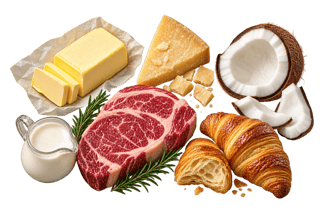
The saturated fats. The 2026 US guideline names red meat, butter, high-fat milk, coconut oil, and palm and palm kernel oil, and trans fats as well. Replace them with olive or vegetable oils, nuts, seeds and fish rather than with sugar and white bread.
What we’d do
Swap, don’t just cut. The butter goes and the olive oil comes in, the steak gets smaller and the beans get bigger, the cheese becomes a handful of nuts. Every 1% of your calories moved from saturated fat to vegetable oils takes about 2 points off LDL, and swapping it for sugar gets you the least.
Why people get the list wrong
They avoid the cholesterol in food, like eggs, and keep the butter, cheese and coconut oil. The guideline says limiting saturated fat while adding unsaturated fat lowers LDL more reliably than cutting dietary cholesterol. Some of the worst offenders don’t look like it.
The saturated fat in real portions
| Food | Saturated fat |
|---|---|
| 1 tablespoon of coconut oil | 11.2 g |
| 1 tablespoon of butter | 7.3 g |
| A butter croissant | 6.7 g |
| 1 oz of cheddar | 5.4 g |
| 3 oz of cooked sirloin | 4.8 g |
| A cup of whole milk | 4.5 g |
| 1 tablespoon of olive oil | 1.9 g |
| 1 tablespoon of canola oil | 1.0 g |
The surprise is the croissant, which carries more saturated fat than a 3 oz steak, thanks to the butter folded into it. And the jar of coconut oil sold as a health food beats butter spoon for spoon.
What to put in their place
The swap decides how much LDL you lose. In Mensink’s analysis of feeding trials for the World Health Organization, each 1% of your calories moved out of saturated fat lowered LDL by about:
| Moved to | LDL per 1% of calories | At 5% of calories |
|---|---|---|
| Vegetable oils and nuts (polyunsaturated) | 2.1 mg/dL | about 11 |
| Olive oil and avocado (monounsaturated) | 1.6 mg/dL | about 8 |
| Carbs | 1.3 mg/dL | about 6 |
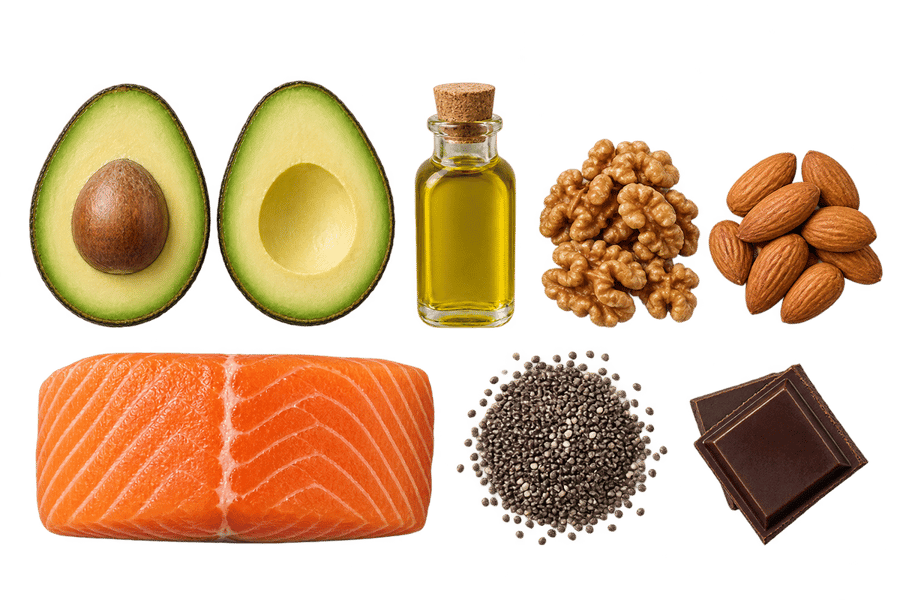
At 2,000 calories, 1% is about 2.2 g of fat. The guideline lists the good swaps as fish, nuts, flax and chia seeds, and corn, sunflower and soybean oils for polyunsaturated fat, and olive oil, avocados and nuts for monounsaturated.
It’s like moving money between accounts. Cutting butter is the withdrawal, and where you put the calories decides what you earn.
Why not sugar
Swapping saturated fat for carbs does the least for LDL, and sugar brings problems of its own. In 37 trials, higher-sugar diets raised triglycerides about 10 points and LDL about 5. The guideline warns that the benefit of the fat swap “can be offset by excess processed sugar.”
Eggs are a smaller worry than most people think (do eggs raise cholesterol?). Test your instincts on ten pairs of foods in Higher or lower.
5 sources
- Blumenthal RS, Morris PB, Gaudino M and others, 2026 ACC/AHA guideline on the management of dyslipidemia, JACC, 2026doi.org
- The same guideline, full text, Circulation, 2026api.iscpcardio.org
- Mensink RP, Effects of saturated fatty acids on serum lipids and lipoproteins, World Health Organization, 2016, as tabulated by Food Standards Australia New Zealandfoodstandards.gov.au
- Te Morenga LA, Howatson AJ, Jones RM and Mann J, Dietary sugars and cardiometabolic risk, American Journal of Clinical Nutrition, 2014pubmed.ncbi.nlm.nih.gov
- US Department of Agriculture, FoodData Central, SR Legacy 173410 (butter), 171412 (coconut oil), 173414 (cheddar), 168727 (sirloin), 174987 (croissant), 171265 (whole milk), 171413 (olive oil) and 172336 (canola oil)fdc.nal.usda.gov