Does saturated fat matter for cholesterol?
On this page
Yes, for LDL. Moving 1% of your calories from saturated fat to vegetable oils takes about 2 mg/dL off LDL, in 69 feeding trials. In trials that cut saturated fat, heart events fell 21%. But what you eat instead decides how much your heart gains, and swapping butter for sugar gets you almost nothing.
What we’d do
Find the two foods that bring the most saturated fat into your week, usually butter, cheese, fatty meat, coconut oil or pastry. Replace them with olive or vegetable oils, nuts, fish or beans, not with white bread and sweets. Retest in 6 to 12 weeks at the same lab.
Why people are confused
“Butter is back” has been a headline for years. A 2010 analysis of studies following 347,747 people found no link between saturated fat and heart disease, and a 2020 review by Arne Astrup and colleagues argued that whole-fat dairy, unprocessed meat and dark chocolate aren’t linked to heart disease either. At the same time, the 2026 US guideline still tells people to replace saturated fat with unsaturated fats to lower LDL. Both can be true, once you look at what was swapped in.
What it does to LDL
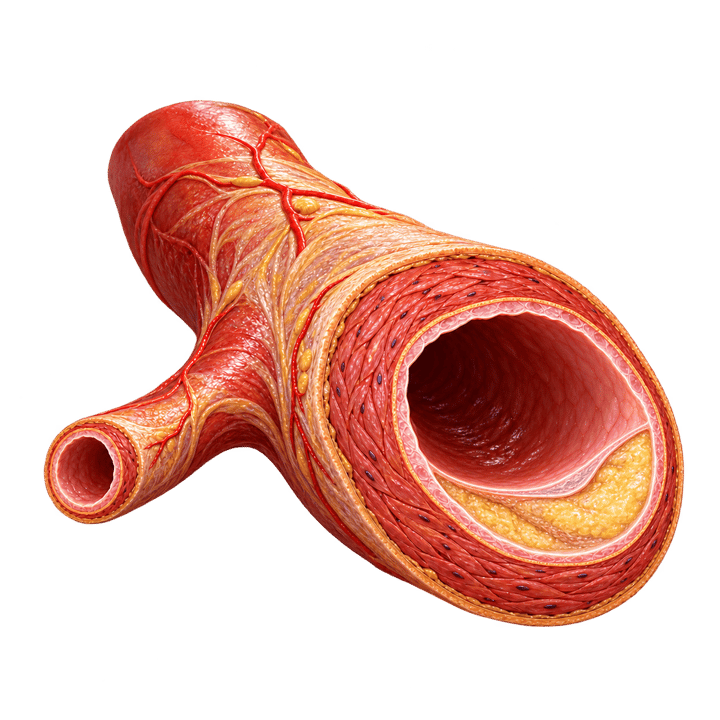
The size is well measured. In 69 controlled feeding trials pooled for the World Health Organization, each 1% of calories moved from saturated fat lowered LDL about 2.1 mg/dL when it went to vegetable oils, 1.6 to olive oil and 1.3 to carbs. At 2,000 calories, 1% is about 2.2 g of fat, so a 5% swap, about 11 g a day, takes off about 11 points. Saturated fat slows the liver’s LDL receptors, the drain that clears LDL from your blood (how it works).
What you swap it for decides it
In a large US study that followed people for 24 to 30 years, replacing 5% of calories from saturated fat with polyunsaturated fat went with 25% less heart disease, with monounsaturated fat 15% less and with whole grains 9% less. Replacing it with refined starch and added sugar went with no benefit. That explains the 2010 result. Those studies compared people who ate more saturated fat with people who ate more of something else, and the something else was often no better.
Trials agree on the direction. The Cochrane review of 15 trials and about 59,000 people found 21% fewer heart attacks, strokes and other heart events when people ate less saturated fat, and bigger cholesterol drops brought bigger benefits. It found little or no effect on deaths. One recovered 1960s trial, in which corn oil and margarine replaced animal fat, lowered cholesterol and didn’t lower deaths, so a single vegetable oil isn’t a proven lifesaver (Does LDL really matter?).
The food matrix question
Cheese and butter carry about the same saturated fat but sit in different foods, and some researchers think the whole food changes the effect. Astrup’s group also argued that saturated fat mostly raises larger LDL particles, which they consider less harmful. The counterpoint is that each ApoB particle can get into the artery wall, and except for Lp(a) and some rare remnants, they’re about equally harmful whatever their size. The particle count counts. Nobody has settled the dairy question with long randomized trials, and as of November 2026 it’s still open.
Where it hides
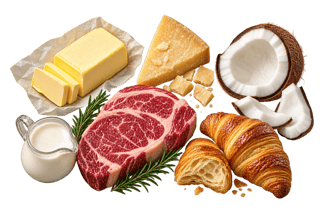
The guideline names red meat, butter, high-fat milk, coconut oil and palm oil. Higher or lower? shows how well you can spot it, and fats.guide has the foods, the daily amounts and how much to aim for with high cholesterol.
8 sources
- Mensink RP, Effects of saturated fatty acids on serum lipids and lipoproteins, World Health Organization, 2016, as tabulated by Food Standards Australia New Zealandfoodstandards.gov.au
- Hooper L and others, Reduction in saturated fat intake for cardiovascular disease, Cochrane Database of Systematic Reviews, 2020pubmed.ncbi.nlm.nih.gov
- Li Y, Hruby A, Bernstein AM and others, Saturated fats compared with unsaturated fats and sources of carbohydrates in relation to risk of coronary heart disease, JACC, 2015pubmed.ncbi.nlm.nih.gov
- Siri-Tarino PW, Sun Q, Hu FB, Krauss RM, Meta-analysis of prospective cohort studies evaluating the association of saturated fat with cardiovascular disease, American Journal of Clinical Nutrition, 2010pubmed.ncbi.nlm.nih.gov
- Astrup A, Magkos F, Bier DM and others, Saturated fats and health: a reassessment and proposal for food-based recommendations, JACC, 2020pubmed.ncbi.nlm.nih.gov
- Ramsden CE and others, Re-evaluation of the traditional diet-heart hypothesis: analysis of recovered data from Minnesota Coronary Experiment (1968-73), BMJ, 2016pubmed.ncbi.nlm.nih.gov
- Sniderman AD, Thanassoulis G, Glavinovic T and others, Apolipoprotein B particles and cardiovascular disease: a narrative review, JAMA Cardiology, 2019pubmed.ncbi.nlm.nih.gov
- Blumenthal RS, Morris PB, Gaudino M and others, 2026 ACC/AHA guideline on the management of dyslipidemia, Circulation, 2026api.iscpcardio.org