Is an LDL of 130 bad?
On this page
It’s above every goal in the 2026 US guideline: under 100 mg/dL at borderline or intermediate risk, under 70 at high risk and under 55 after a heart attack or stroke. At low risk there’s no number goal. An LDL of 130 is 3.4 mmol/L.
What we’d do
Don’t panic, and don’t shrug it off for twenty years either. At borderline or intermediate risk you’re 30 points from your goal, and food changes can often close a gap that size. At high risk or with heart disease the gap is 60 or 75 points, which is more than any single food change in trials has done, so that’s a conversation with your doctor.
Why 130 feels normal
Because it is common. The guideline says about a quarter of US adults have an LDL of 130 or more. And the range printed on your report is one line for everyone, while the goal depends on your risk, which the lab doesn’t know.
How far 130 is from each goal
| Your 10-year risk (your doctor works it out) | LDL goal | Gap from 130 |
|---|---|---|
| Low, under 3% | no number goal | none |
| Borderline or intermediate, 3 to under 10% | under 100 (2.6) | 30 |
| Diabetes, ages 40 to 75 | under 100, or under 70 if your risk is over 10% | 30 or 60 |
| High, 10% or more | under 70 (1.8) | 60 |
| After a heart attack, stroke, stent or bypass | under 55 (1.4), or under 70 if your doctor says you’re not at very high risk | 75 or 60 |
What food can do against the gap
| Change | LDL, in trials | Trials |
|---|---|---|
| 10 g of psyllium husk a day | about 13 lower (10 to 15) | 28 trials, 1,924 people |
| 5% of calories moved from saturated fat to vegetable oils | about 11 lower (10 to 12) | 69 feeding trials |
| About 3.5 g of oat beta-glucan a day | about 7 lower (5 to 9) | 58 trials, 3,974 people |
| The portfolio diet (soy, nuts, oats and a sterol spread) for a month | 28.6% lower, about 37 from 130 | 46 adults |
Trials tested these one at a time. Together they usually add up to less than the sum, and nobody has measured how much less. What would lower yours? shows each one against your own gap.
Why a modest LDL still counts
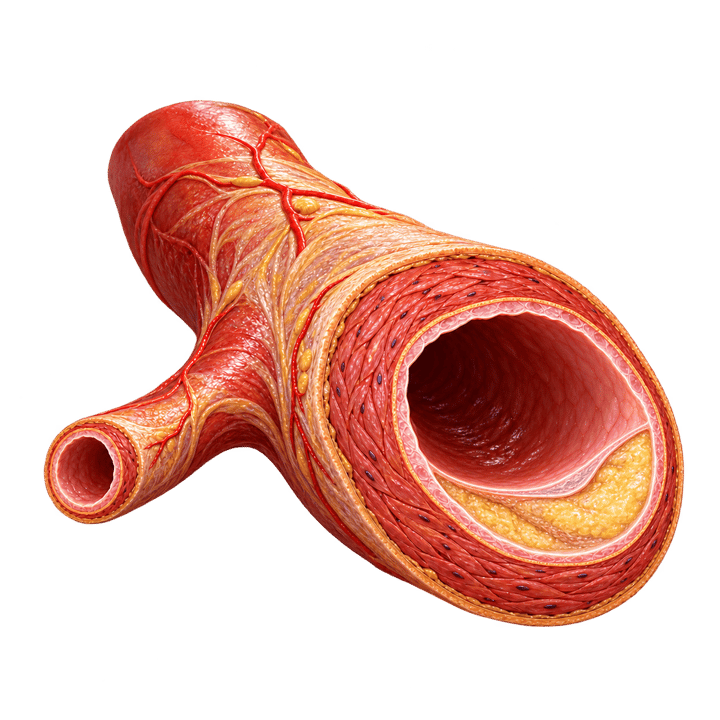
Plaque builds with how high your LDL is and for how many years. In the US ARIC study, 2.6% of 3,363 Black participants were born with a broken PCSK9 gene. Their LDL was 28% lower all their lives, and over 15 years they had 88% less coronary heart disease. In drug trials lasting about five years, each 39 mg/dL lower LDL cut heart attacks, strokes and artery procedures by about a fifth. A drop held from youth bought far more protection than a similar drop started late.
Check that it’s real before you act
At an LDL of 130, two tests can differ by about 24 points with nothing changed, and now and then by 37. Retest at the same lab before you decide anything, and use Did it really go down? to compare the two.
10 sources
- Blumenthal RS, Morris PB, Gaudino M and others, 2026 ACC/AHA guideline on the management of dyslipidemia, JACC, 2026doi.org
- The same guideline, full text, Circulation, 2026api.iscpcardio.org
- Labcorp, 2026 ACC/AHA dyslipidemia guideline updatelabcorp.com
- Jovanovski E and others, Effect of psyllium fiber on LDL cholesterol and alternative lipid targets, non-HDL cholesterol and apolipoprotein B, American Journal of Clinical Nutrition, 2018pubmed.ncbi.nlm.nih.gov
- Ho HV and others, The effect of oat beta-glucan on LDL-cholesterol, non-HDL-cholesterol and apoB for CVD risk reduction, British Journal of Nutrition, 2016pubmed.ncbi.nlm.nih.gov
- Mensink RP, Effects of saturated fatty acids on serum lipids and lipoproteins, World Health Organization, 2016, as tabulated by Food Standards Australia New Zealandfoodstandards.gov.au
- Jenkins DJ and others, Effects of a dietary portfolio of cholesterol-lowering foods vs lovastatin on serum lipids and C-reactive protein, JAMA, 2003pubmed.ncbi.nlm.nih.gov
- Cohen JC, Boerwinkle E, Mosley TH and Hobbs HH, Sequence variations in PCSK9, low LDL, and protection against coronary heart disease, New England Journal of Medicine, 2006pubmed.ncbi.nlm.nih.gov
- Cholesterol Treatment Trialists' Collaboration, Efficacy and safety of more intensive lowering of LDL cholesterol: a meta-analysis of data from 170,000 participants in 26 randomised trials, Lancet, 2010pubmed.ncbi.nlm.nih.gov
- Smith SJ, Cooper GR, Myers GL and Sampson EJ, Biological variability in concentrations of serum lipids, Clinical Chemistry, 1993pubmed.ncbi.nlm.nih.gov