How long does it take to lower cholesterol?
On this page
Weeks, not months. LDL fell 28.6% within a month on the portfolio diet, and triglycerides respond to changes in food and drink in the same few weeks. Retest LDL 6 to 12 weeks after your change and triglycerides after 4, at the same lab, and allow for the noise.
What we’d do
Make the change, give it 6 to 12 weeks for LDL and 4 for triglycerides, then retest the same way you tested before. Don’t retest at 2 weeks, since a small drop that early is mostly noise. And once it’s down, keep it down. The number moves in weeks, but your arteries count the years.
Why people expect it to take forever
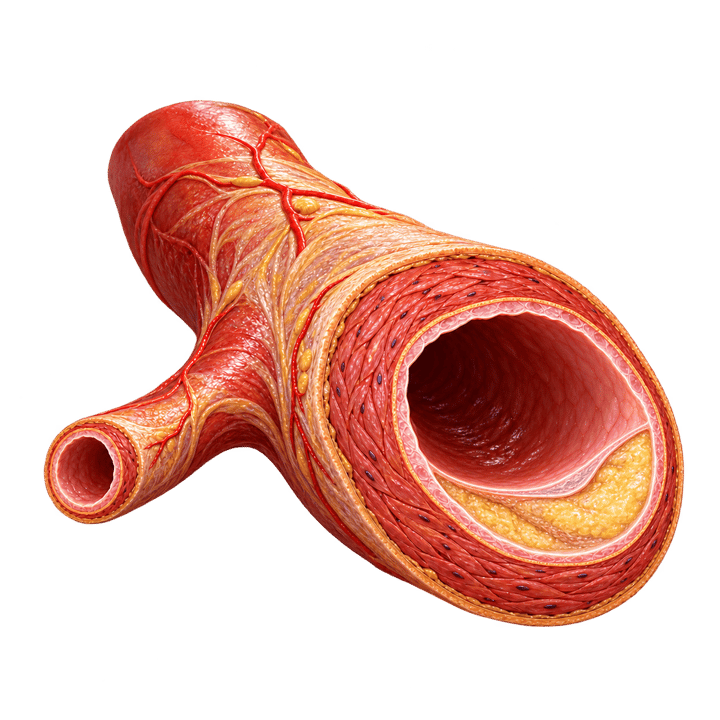
Cholesterol builds plaque over decades, so it feels like it should take years to move. The number on your panel is much quicker than the plaque. In the trials below, most food changes showed their effect within a month or so.
How fast each change showed up
| Change | How long the trials ran | LDL or triglycerides |
|---|---|---|
| The portfolio diet (soy, nuts, viscous fiber and a sterol spread) | 4 weeks, measured at 2 and 4 | LDL 28.6% lower |
| 10 g of psyllium husk a day | at least 3 weeks | LDL about 13 lower |
| About 3.5 g of oat beta-glucan a day | at least 3 weeks | LDL about 7 lower |
| Less sugar | at least 2 weeks | triglycerides about 10 lower |
| Losing weight | 6 to 12 months | LDL about 8 lower, triglycerides about 12 lower |
| Starting or changing a cholesterol medicine | the guideline checks at 4 to 12 weeks | 30 to 49% lower at moderate intensity, 50% or more at high |
Weight takes longer because losing it takes longer. The guideline calls high triglycerides persistent only after 4 to 12 weeks of lifestyle change, which gives you a fair window to see your own result.

Why a quick retest can fool you
Your cholesterol drifts with nothing changed. Two LDL results can differ by about 19% by chance, and now and then by 29%. At an LDL of 130, that’s 24 points, which is bigger than what psyllium does on its own. A retest too soon, at a different lab, or fasting one time and not the other can hide a real drop or invent a fake one. Did it really go down? tells you whether your change is bigger than the noise.
The part that takes years
Lowering LDL is like paying down a credit card. The balance drops the day you pay, but the interest you save adds up over years. People in the US ARIC study born with a PCSK9 gene change had 28% lower LDL their whole lives and 88% less coronary heart disease over 15 years. A drop held for decades bought more than a similar drop in a few years of drug trials.
The plans put the order and the dates in one place: how to lower your cholesterol for LDL, and the four week plan for triglycerides.
9 sources
- Jenkins DJ and others, Effects of a dietary portfolio of cholesterol-lowering foods vs lovastatin on serum lipids and C-reactive protein, JAMA, 2003pubmed.ncbi.nlm.nih.gov
- Jovanovski E and others, Effect of psyllium fiber on LDL cholesterol and alternative lipid targets, non-HDL cholesterol and apolipoprotein B, American Journal of Clinical Nutrition, 2018pubmed.ncbi.nlm.nih.gov
- Ho HV and others, The effect of oat beta-glucan on LDL-cholesterol, non-HDL-cholesterol and apoB for CVD risk reduction, British Journal of Nutrition, 2016pubmed.ncbi.nlm.nih.gov
- Te Morenga LA, Howatson AJ, Jones RM and Mann J, Dietary sugars and cardiometabolic risk, American Journal of Clinical Nutrition, 2014pubmed.ncbi.nlm.nih.gov
- Zomer E and others, Interventions that cause weight loss and the impact on cardiovascular risk factors, Obesity Reviews, 2016pubmed.ncbi.nlm.nih.gov
- Blumenthal RS, Morris PB, Gaudino M and others, 2026 ACC/AHA guideline on the management of dyslipidemia, JACC, 2026doi.org
- The same guideline, full text, Circulation, 2026api.iscpcardio.org
- Smith SJ, Cooper GR, Myers GL and Sampson EJ, Biological variability in concentrations of serum lipids, Clinical Chemistry, 1993pubmed.ncbi.nlm.nih.gov
- Cohen JC, Boerwinkle E, Mosley TH and Hobbs HH, Sequence variations in PCSK9, low LDL, and protection against coronary heart disease, New England Journal of Medicine, 2006pubmed.ncbi.nlm.nih.gov