ApoB or LDL: which should I trust?
On this page
LDL is the amount of cholesterol inside your LDL particles. ApoB counts the particles themselves. Most of the time the two agree. With high triglycerides, diabetes or extra weight they can split, and the 2026 US guideline says ApoB is the better guide when they do.
What we’d do
For most people, an LDL from a modern equation plus non-HDL tells you what an ApoB would. Ask for ApoB if your triglycerides are high, you have diabetes, or you’re on treatment and already at your LDL goal. If yours comes back at 120 mg/dL or more, that’s on the guideline’s list of things that raise risk, so take it to your doctor.
Why there are two numbers
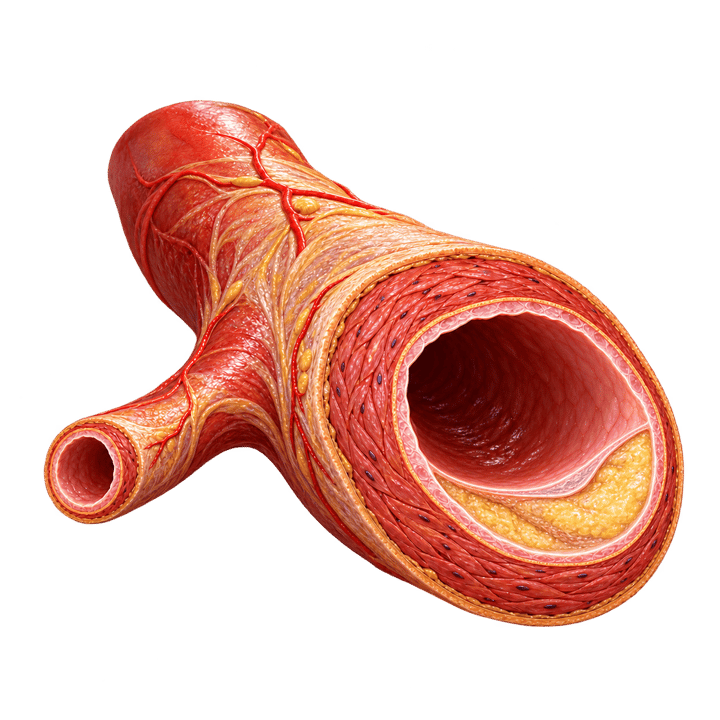
Every particle that can build plaque, whether it’s LDL, a triglyceride-rich particle from the liver or Lp(a), carries exactly one ApoB protein. Counting ApoB counts those particles. LDL cholesterol measures how much cholesterol is packed inside the LDL ones.
Think of cars on a road. LDL cholesterol counts the passengers, and ApoB counts the cars. Usually the two go together. But if every car carries fewer passengers, the passenger count can look fine while the road is packed.
When they disagree
The guideline says the two split most often in people with heart disease, diabetes, kidney and metabolic problems, or triglycerides of 150 or more, where LDL particles tend to carry less cholesterol each. LDL can look at goal while ApoB stays high, which hides risk. When they disagree, the guideline says ApoB predicts heart disease more accurately.
How your LDL was worked out makes a big difference. With the newer Martin/Hopkins equation, only about 2% of people with an LDL under 70 and about 1% under 100 had a non-HDL and ApoB above the goals. Most of the disagreement shows up with the old 1972 formula (see why does my report say my LDL is calculated?).
When the guideline says to test it
- It’s reasonable for adults on cholesterol treatment, above all with heart disease, diabetes, kidney and metabolic problems or high triglycerides, once their LDL and non-HDL goals are met.
- It may be reasonable for adults not on treatment, to sharpen their risk or help decide on treatment.
ApoB doesn’t need fasting. In 33,391 Danish adults, it didn’t change at all after a meal, while triglycerides rose by up to 26 points.
The one ApoB line on this site
The guideline lists an ApoB of 120 mg/dL (1.2 g/L) or more among the things that raise risk. Put your ApoB into the check below and it tells you which side of 120 you’re on. ApoB is reported in mg/dL or g/L, and g/L is mg/dL divided by 100.
The same food changes that lower LDL lower ApoB too. In trials, 10 g of psyllium a day took ApoB down about 5 mg/dL.
The ApoB goals by risk are on apob.guide, with a checker that holds your own ApoB against them, and how to lower it in its plan.
4 sources
- Blumenthal RS, Morris PB, Gaudino M and others, 2026 ACC/AHA guideline on the management of dyslipidemia, JACC, 2026doi.org
- The same guideline, full text, Circulation, 2026api.iscpcardio.org
- Langsted A, Freiberg JJ and Nordestgaard BG, Fasting and nonfasting lipid levels: influence of normal food intake on lipids, lipoproteins, apolipoproteins, and cardiovascular risk prediction, Circulation, 2008pubmed.ncbi.nlm.nih.gov
- Jovanovski E and others, Effect of psyllium fiber on LDL cholesterol and alternative lipid targets, non-HDL cholesterol and apolipoprotein B, American Journal of Clinical Nutrition, 2018pubmed.ncbi.nlm.nih.gov